

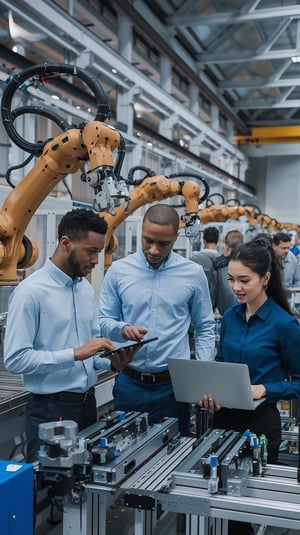
Imagine this: A new employee from Hungary is standing at the assembly line and has to carry out a complex work step. She only understands the written instructions in fragments and doesn't dare to ask. The experienced colleague who was supposed to train her is busy with his own tasks. At the end of the day, a mistake is made that requires rework - and we as production managers are once again solving problems instead of managing production efficiently.
The reality in German industry shows: We now work with people from over 150 nations. According to the Federal Employment Agency, the proportion of foreign employees in the manufacturing industry was 15.4 percent in 2023 - and the trend is rising. For us as production managers, this means that safety risks are increasing, error rates are rising and training new colleagues is taking longer than planned. At the same time, our experienced employees are being kept away from their actual work.
The good news is that modern digital solutions can break this spiral.
Why language barriers are becoming a critical production factor
Demographic trends are forcing us to act. According to the Institute for Employment Research (IAB), there will be a shortage of around seven million workers by 2035. Production cannot be maintained without international skilled workers.
Safety risks and loss of quality
Language communication problems directly jeopardize occupational safety. The German Social Accident Insurance (DGUV) shows that communication deficits play a role in around 25 percent of all accidents at work - particularly when handling hazardous substances, operating machinery or in emergency situations.
Misinterpreted work instructions also lead to rejects, rework and complaints. According to the Fraunhofer Institute for Production Technology, inadequate communication in production costs an average of 3-5 percent of production costs. For us, every error chain means additional coordination effort that we actually want to avoid.
Double burden for experienced employees
Long-serving specialists know the problem all too well: in addition to their actual work, they have to instruct new colleagues, often without sufficient time or suitable tools. Although work instructions exist, they often do not fit in with practice. This frustrates both sides and ties up capacity that is lacking elsewhere.
Traditional solutions and their limitations
Many companies rely on language courses, tandem programs or multilingual key personnel. These measures make sense, but quickly reach their limits.
-
Language courses take time: job-related German teaches specialist vocabulary - but it takes months for an employee to communicate confidently. During this time, risks remain.
-
Translator apps are not enough: Tools such as DeepL deliver usable results for everyday communication, but often produce incorrect translations when it comes to specialist terminology. They are impractical in day-to-day production - hands are dirty, gloves get in the way, time pressure prevails.
-
Multilingual employees as a bottleneck: language mediators are valuable, but not always available. Shift work, vacation or illness lead to gaps. At the same time, these employees are kept away from their actual work - a vicious circle that puts a strain on productivity.
Digital worker guidance: language becomes superfluous
A modern approach does not rely on better translation, but on visual communication. Digital worker guidance systems show work steps as images, videos or animations, regardless of the native language.
How visual work instructions work
Our employees can see on a screen or tablet exactly which action is next: Which tool? Which position? Which sequence? Text only plays a subordinate role - or is omitted altogether.
Advantages for everyone involved
-
For production managers: Fewer queries, fewer corrections, fewer conflicts due to misunderstandings. Greater transparency about current production steps.
-
For experienced employees: The overload caused by constant instructions is eliminated. Their specialist knowledge flows once into the creation of the instructions - then the system works.
-
For new employees: Step-by-step instructions provide security, even without perfect language skills. Acclimatization to the new work culture is quicker.
-
For work preparation: clear, comprehensible work instructions can be created once and rolled out consistently. Coordination of different orders becomes easier.
Integration of safety instructions
Hazard warnings appear in context exactly when they are relevant - directly at the workplace. Pictograms and warning symbols are internationally understandable and do not require language skills.
Success factors for the introduction
Integrate practical knowledge
Experienced employees often know better than any documentation how a work step really works. Their knowledge should be incorporated when creating the visual instructions.
Gradual introduction
Pilot areas make it possible to gather experience and optimize the system before it is rolled out company-wide.
Define measurable results
Relevant key figures are training time, error rate, accident figures and the time that experienced employees spend on instructions.
Don't forget cultural aspects
Language is only part of the challenge. In some cultures, it is considered impolite to interrupt superiors or signal a lack of understanding. Digital worker guidance elegantly avoids this problem: the answer appears automatically on the screen.
Conclusion
Language barriers in production jeopardize safety, quality and efficiency. They put a strain on us as production managers and overburden experienced employees who are also required to give instructions. Digital worker guidance systems offer an effective solution: they communicate visually, can be used immediately and noticeably relieve the burden on everyone involved. Companies that take this approach reduce training times, lower error rates and free up time for the tasks that really count.
Sources:
-
Federal Employment Agency (2023): Labor market statistics - employees by nationality
-
Institute for Employment Research (IAB) (2023): Projection of the labor force potential until 2060
-
German Social Accident Insurance (DGUV) (2022): Accident statistics and prevention report
-
Fraunhofer Institute for Production Technology (IPT) (2021): Study on communication costs in manufacturing