

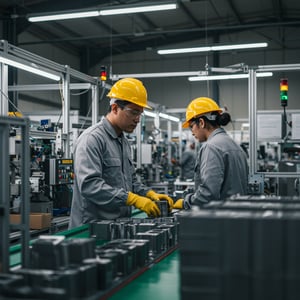
Teams working in industrial production today are more diverse than ever before. Specialists from different countries come together, languages and previous experience differ - but the requirements remain the same: processes must run safely, efficiently and error-free.
At the same time, the shortage of skilled workers is accelerating change. Many companies are recruiting new employees from abroad or relying on lateral entrants who need to be trained quickly. But how can integration succeed when traditional work instructions come up against language barriers?
Diversity on the production line: both an opportunity and a challenge
International teams bring potential to the factory floor: different perspectives, experiences and learning styles. This diversity can lead to better results - if communication works.
In many production environments, however, the opposite is true. Translated documents are understood differently, technical terms are misunderstood and explanations take time. This is a problem in everyday work under time pressure: any ambiguity means delays, rework or quality risks.
These difficulties are not the result of a lack of motivation, but of structural hurdles. Without a common language, the common working basis is weak - and this is precisely where visual process management comes in.
Communication without words
Images, markings and pictograms are understood internationally.
What has long been standard in safety communication can also be transferred to manufacturing and assembly processes.
Instead of long text instructions, visual representations show precisely how a work step is to be carried out.
This allows employees to see not only what needs to be done, but also how it is done.
Why this approach works:
- Visual information is grasped more quickly than language.
- There are fewer misunderstandings and training costs are reduced.
- New employees can learn directly in the process - instead of after several days of training.
The principle is clear: communication becomes universal. Regardless of language or prior knowledge, everyone involved understands the same processes.
How to successfully introduce visual leadership
If you want to integrate international teams productively, you need a concept that communicates knowledge in a structured and understandable way.
The following orientation has proven itself in many production environments:
- Analyze processes: Which work steps regularly lead to queries or errors? These are suitable as a starting point for visual processing.
- Visualize content: Illustrate work steps step by step - use photos, symbols, short videos or illustrative graphics.
- Create standards: Define uniform design, colors and symbols for all locations and teams.
- Integrate feedback: Involve new employees, test how comprehensible the instructions really are. Understand learning as a joint process.
With such a framework, instructions can not only be presented, but also systematically improved. Work documentation becomes a means of communication - clear, comprehensible and independent of language.
Learning processes in the workflow
Visual process management also changes how integration takes place. Learning no longer takes place in isolation in training rooms, but directly in production. New employees immediately recognize whether they are carrying out the steps correctly and can monitor themselves.
This not only speeds up the induction process, but also promotes independence and motivation.
Experienced employees are relieved because they need less time for personal explanations.
Quality, safety and cohesion
Visual instructions have a measurable impact on quality and safety.
Processes are reproducible, inspections are traceable and safety requirements are uniformly adhered to.
For international teams, this creates a common understanding that replaces language differences - a basis on which trust can develop.
At the same time, visual communication also strengthens team spirit. When everyone sees the same information, they work on the same basis. This reduces frustration and misunderstandings and increases the sense of belonging.
Integration as a strategic goal
The successful integration of international employees is more than just a personnel task - it is part of strategic production planning.
Companies that make their processes visually comprehensible not only ensure productivity, but also cultural stability.
This turns diversity from a risk into a strength - and integration leads to quality.
Conclusion
Efficient collaboration in international teams succeeds when information knows no language barriers.
Visual leadership creates clarity, reduces training times and ensures consistent process quality - regardless of origin or experience.
Especially in times of a shortage of skilled workers, this is a decisive step towards sharing knowledge, promoting motivation and ensuring long-term production stability.